How does…
the conical-screw technology work?
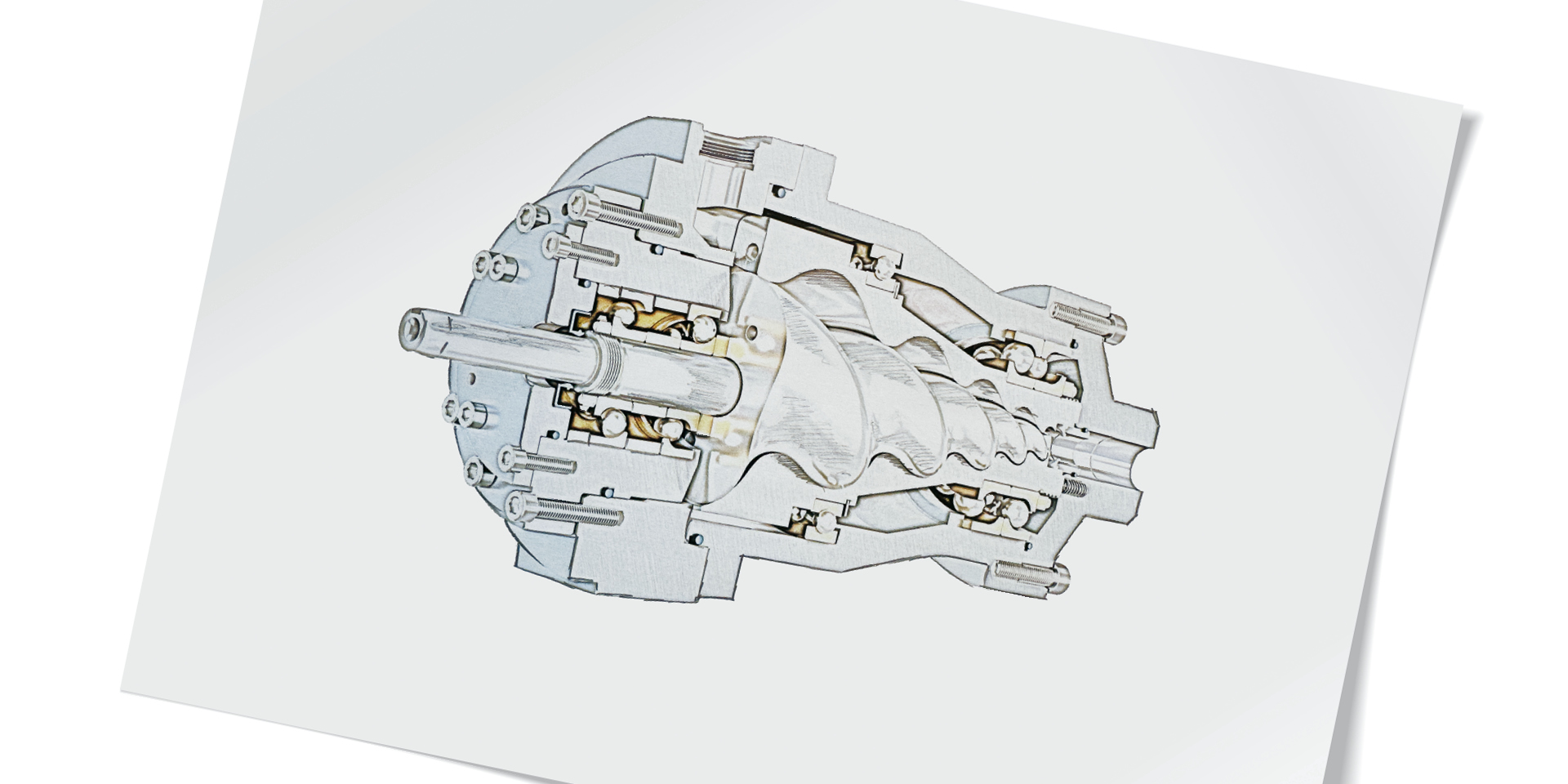
With its Emission Recovery System (ERS), HOERBIGER is making further progress in climate protection. Based on the company’s proprietary conical-screw technology, the ERS recovers natural gas that escapes from compressor seals, compresses it, and returns it to the process. We spoke with Christian Hold, Head of Business Venture Conical Screw, and asked him what role the conical screw plays in this system, where the ERS is used, and how it contributes to climate protection.
Christian, how does the Emission Recovery System (ERS) work?
Christian Hold — The ERS captures natural gas that normally escapes from compressors and feeds it back into the process. This means that methane is no longer released uncontrollably into the atmosphere or flared off but is recovered and utilized. As a result, the amount of harmful emissions is significantly reduced because the gas remains in the cycle.
And what is the function of the conical screw in this process?
CH — The conical screw is the heart of the ERS. Two conical rotors rotate inside one another and compress the gas between them. The system can flexibly handle different pressure ranges and process parameters and efficiently refine the gas further.
You’ll have to explain that to us in more detail. How does the ERS recover escaping natural gas?
CH — The system specifically captures gas that escapes from compressor seals. This gas is compressed between the conical rotors and then fed back into the process. Because the system is hermetically sealed, no additional emissions are produced.
And what happens to the compressed gas then?
CH — The compressed gas is fed directly back into the plant without any detours. This creates a closed loop, allowing customers to directly meet their emissions reduction targets.
Fascinating. And how exactly does the ERS contribute to climate protection and CO₂ reduction?
CH — By recovering methane, greenhouse gas emissions are avoided. In test operations to date, this corresponds to a reduction of more than 1,850 metric tons of CO₂ equivalent. That’s comparable to the annual electricity consumption of about 1,000 households. In this way, the ERS measurably improves the carbon footprint of facilities.
Those are impressive figures. Who is interested in this technology?
CH — Our customers come from across the entire gas value chain, for example from gas and biogas production, transport via pipelines, and LNG applications. The first systems have already been sold in North America; there is an initial order in Europe and growing demand in the Asia-Pacific region, such as in Australia and New Zealand. The system is particularly in demand among companies that want to reduce their emissions and prepare for future environmental requirements.